Monday, June 16, 2008

Still spindrifting

As my faithful reader Amoena already knows, I visited her last week. (Or the week before that, I'm getting confused because of so many things happening in my life lately.)

It was the first time ever since I've known her. I've only known her for, what, five years?! It was about time I saw her humble abode. It was really nice of her to let me stay at hers during my conference trip.

I don't know how she felt about it, seeing that I had to hog her bed due to reasons of practicality, while she had to sleep on the couch.

On top of that, her work mate thought she was a lesbian because I was staying overnight and, you know, I'm a female. The situation calls for a lol, even though I try to avoid that expression elsewhere but in online chats. The thought still cracks me up. I didn't do wonders for her reputation.

Personally, I thought it was a surprisingly nice visit. Even though we've only met "in real life" a couple of times, it felt comfortable and not at all awkward.

We didn't do anything special. I came back from the conference so late in the evening that we didn't really have time for much. On Monday, we watched Desperate Housewives with a friend of hers, then Californication, followed by some Bible channel show. I've got to find out if I have that channel here - it was hilarious.

Amoena has often commented on how cosy my apartment looks and feels. I could say the same of hers. It had so much space, soothingly white walls, and there wasn't as much stuff lying around as in mine. She also had some interesting decorative items, and an impressive bookshelf. I usually keep my own books on the floor out of convenience.

She had so many classics as well as some praised contemporary writers there. I admire so much her ability to not be a genre reader. You'd be hard pressed to label her taste in books. Eclectic, perhaps?

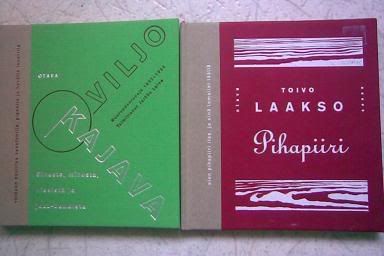
She had stowed in her closet a big box full of some old books that she was willing to give away. I came back home with several kilograms' worth of books. They're all written in Finnish, so it's going to be fun to read books in Finnish for a change. Here are for instance two poetry collections of Viljo Kajava and Toivo Laakso that she gave me:

Laakso ja Kajava

It's a strange experience to read something in your mother tongue as though it was a foreign language. I'm a little concerned about this. I think I should try to find an opportunity to write more in Finnish, and more often. Chatting on the internet doesn't count.

There is this article I've been trying to write in Finnish for weeks now. All I can come up with are English sentences. It's not that my English is better than my Finnish by any accounts, but for some reason I find it easier to sort my thoughts in English.

It probably also has something to do with your mother tongue feeling more personal, and consequently you pay more attention to your choice of words.

Besides, there are just too many choices because your vocabulary isn't as limited as with a foreign language. But since Finnish teachers think that you have to master your mother tongue before you can master any other languages, I suppose I must do my utmost to practise it more.

Oh and may I point out to Amoena that I finally took heed of her advice: I shrank the banner. See, I'm not completely stubborn. I guess my honeymoon period with that picture is over, since it no longer pained me to distort its proportions.

Thursday, June 12, 2008

Afterthoughts

I'm still trying to gather my thoughts regarding a recent linguistics conference visit to Helsinki. It was my first time in a conference, and I didn't really have any idea what it would be like.

Thankfully, I didn't give a "real" presentation just yet, but only a poster presentation. Even so, I had to quickly introduce the topic of my poster in two minutes, and by the end of those longest minutes in my life so far, I could barely get the words out of my mouth.

But it wasn't critical, as I could explain everything without stress afterwards during the poster session to anyone who was interested. Quite a few of the people there were, probably because they couldn't hear anything from my stuttery introduction. But I don't really care. I'll just practise more for an actual presentation in August in München.

Maybe I should take lessons in producing speech properly, as one Scottish woman thought I absolutely should in order to survive in this world. Or not.

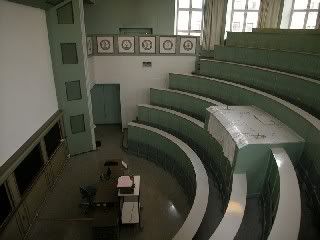
The conference was held in an old auditorium where they used to cut bodies open to show medical students what people look like inside. Fascinating. I've always wondered how doctors can understand anything of what they see inside a human's body. To my eyes, the viscera are just a bunch of some red stuff all jumbled up together.

Helsinki auditorium 107

The makeup of the auditorium wasn't too ergonomic, though. If you sat in the front row, your neck would be really stiff because of having to look so high up on the projection screen. And if all the listeners where sitting in the highermost rows, the speaker would get their neck stiff from having to look upwards so much.

I was quite nervous the first day, and drinking a glass of wine into an empty stomach in the evening didn't help my mood much. But by the third day, I was already trying to chat up other people. I congratulated myself on that.

The first day was very computational, and I couldn't really make sense of anything because of my non-existent background in statistics. However, I think I understand better now why many linguists these days have endorsed number crunching.

I suppose I was preinclined to think it's all rubbish to play around with numbers too much, in a way distancing yourself from actual manifestations of language use. I had let myself be influenced by other, more experienced people who didn't see much use in statistics. One more reason why you should look up to your elders and betters, but always take their advice and opinions with a grain of salt.

It really isn't about distancing yourself from language. I think it's just about linguists wanting to gain more credibility for their field of research, a problem I suppose any subject in humanities must face. In a twisted way I'm even looking forward to learning more about statistics. This from a girl who wanted to escape mathematics forever by studying language.

My name tag for qitl-3 yay

(Don’t laugh. It’s hard to come up with pictures that are actually related to the topic. I'm doing my best to make this post more reader-friendly.)


The second day was more about syntax, which is a field I'm sort of working in myself. Alas, I was still tired from sleeping only 5 hours on two previous nights, so I can't recall much from those presentations. To my relief and joy, the conference organizers emailed today to announce that they're going to put up the presentation slides online for everybody's viewing pleasure. Plus a plethora of somewhat amusing photos.

On the third day, there were some presentations about cross-linguistic typology. It's immensely intriguing from a theoretical point of view, and kudos to all who are courageous enough to try and create some rhyme or reason into such an endeavour.

It all made my own research project seem so small and insignificant. At the moment, I'm fervently trying to develop the topic so that it would seem more worthwhile. One of the linguists at the conference even plain laughed out loud at my poster and then walked away. So officially of course I'm proud of and confident in the importance of my topic, just in case I ever run into more people of his kind.

It didn't really help though to hear from my French friend what his doctoral thesis will be about. I often think he's a jackass (and he doesn't mind me saying so), being French and all that, but he's also a bit of a genius. It boggles my mind how different it is to study history in France. Let alone English. Yes, they do study English over there.

(Picture 1: www.ling.helsinki.fi/sky/tapahtumat/qitl)

Tuesday, June 10, 2008

Banquo by your bedside

Macbeth is probably my favourite by Shakespeare. I also quite like the volume that I own of the play, with the sketchy portrait in bright colours. The font size is big and there are lots of footnotes, so it has a good, hefty feel, even though it's the shortest play he wrote, if I remember correctly.
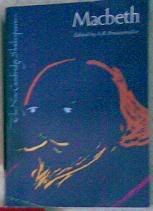
My Macbeth

When I applied to study English philology in university years back, I was young and stupid. I thought it would be just about linguistics. Little did I know that half of the studies are actually about literature. Heaven forbid that I should have taken a look at the syllabi on the university website.

A smarter person would have been able to guess so much from the entrance exam books. For Tampere, you had to read George Yule's Study of Language (which, fair enough, is about linguistics) and Montgomery et al's Ways of Reading (which is about basic theoretical issues in literary studies).
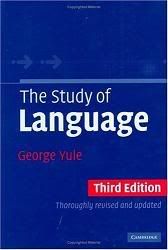
George Yule The Study of Language

Yule's book was very well written, it makes learning about language very easy and even funny. It's a good introduction to the field of linguistics if you have absolutely no prior knowledge of it.

Montgomery and co's book wasn't that bad either, but it was completely misleading as to what literary studies are actually about at university level. (I couldn't even find a decent picture of it, evidence of just how unpopular it must be in general.)
Ways of Reading Montgomery et al

For Turku, you had to read H.G. Widdowson's Linguistics, which was highly theoretical and challenging for a beginner, which fact I very much relished. There's nothing like the orgasmic feeling of expanding your mental horizons by reading something you can't quite understand, at least not immediately.
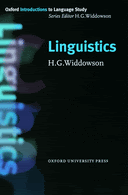
H. G. Widdowson Linguistics

The University of Jyväskylä had The Bluest Eye by Toni Morrison and the aforementioned Ways of Reading as the required readings. I liked the novel, and it was actually a must-read later on in Tampere. Most importantly, when writing an essay about the book in the entrance exam I got to use one of my favourite words in English, soliloquy.

I love the sound of the word: you start with a weak syllable, which is then followed by a quick sequence of closed syllables, and at the end you glide away with a long [e]. The word didn't have much purpose in the essay, but that didn't diminish my feeling of triumph.
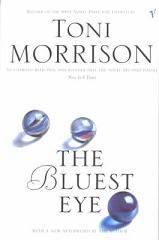
Toni Morrison the Bluest Eye

You might guess now why I chose to apply to these particular universities. I didn't even consider Helsinki, because I would have had to read a set of four completely different books. The strategy paid off, as I got accepted in all three universities.

So I've nothing against literature per se. I was a huge book buff when I was young, though what I read wasn't necessarily anything classic or prestigious. I enjoyed the act of reading, being completely immersed in another world and in somebody else's thoughts and feelings. It was escapism at its finest.

I liked a specific kind of fantasy. I liked for instance Sagan om Isfolket by Margit Sandemo, which is a 47-volume series telling the story of a family of witches from the 17th to the 20th century.

I'm not so fond of the kind with the elves, hobbits, wizards, dragons and whatnot. Somehow I could never buy into those Middle Earth-style worlds where people were stuck in the middle ages. I mean, why is it that they nearly always place fantasy stories in a medieval world?
Generic Fantasy book

The castles and swords and horses and armours and the clothes may look all fancy, but I find it hard to relate to characters who have to live in such a world. Because let's face it, who would seriously want to live like that? I'm reasonably happy in today's Finland where I don't need to know how to use a sword in order to protect myself against the dragons and those nasty little buggers called hobbits.

A fantasy freak might respond to this by saying that it's only fiction, don't take it so seriously. But that's exactly what you should and have to do when studying literature in university. It was a shocker to me to be honest.

While it doesn't necessarily take away from the reading experience to analyse the text closely, I do think it makes the experience dramatically different when compared to a child's way of reading.

As a kid, I used to devour several books a day during holidays, and at least one book a week throughout the year. I didn't stop to think about the symbolic meanings of anything in the books, or what the texts really mean aside from the story and the characters on the surface.
Reading girl Pietro Magnini

It took me a long time to get over my prejudices against literary analysis. The teachers had a role to play in my antipathy, as they seemed to think literature was the be-all and the end-all in the whole wide world (notice the not-so-clever Macbeth quote).

In my mind, literary criticism was equated with elitist assholism. When I didn't do so well with my first literature essay, the teacher flashed me a holier-than-thou smile and asked whether I was going to drop out of uni.

So just because I didn't have a clue after only one course, she thought there was no point in going on. As though literature was the only thing that mattered. My grades weren't that good in linguistics, either, but I knew I would learn eventually because I actually liked it.

Our gentle Shakespeare

So where does our gentle Shakespeare figure in this story of doom and gloom? Well, he made me fall in love with reading again. I totally didn't expect the plays to have such an impact on me. I'd seen some televised versions, but I never saw anything special in them.

I suppose I was really taken by the story of the tragic figure of Macbeth. Seeing a film of the play where he was a very fine young man didn't hurt, either. (I'm a sucker for men with a short beard, and a cute ringmail hood.)
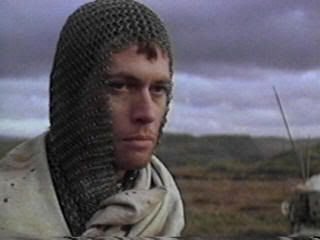
Ringmail hood=sechsay

But truth be told, I have always had a predilection for tragic characters. Call them baddies if you will.

I always find baddies the most interesting characters. In a way, they're the most human of all humans. In real life, everyone likes goody-goodies, to be sure. But stories about thoroughly good and benevolent people make really bad ones. I don't think you can fully relate to someone who is supposedly a perfect human being.

I know some people who don't seem to realize this. They don't see fault in themselves. I've seen them behave in less than moral ways many times, yet they fail to question themselves even afterwards.

How can you grow as a person if you don't see what you're doing wrong? If you never question your own motives and never acknowledge your imperfections, how can you truly accept anyone else's?
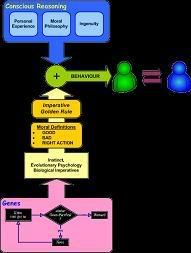
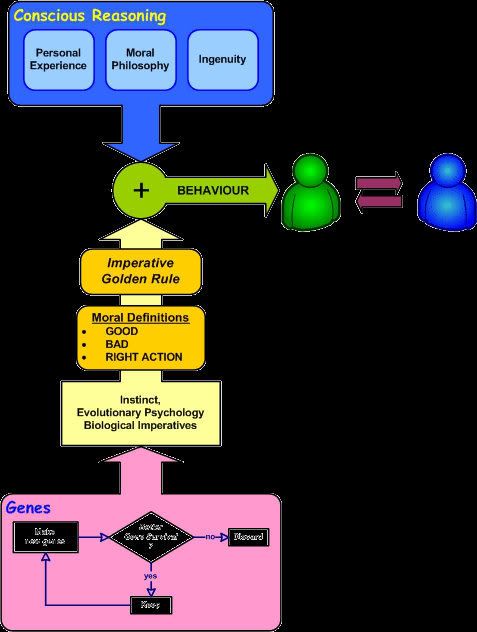
Moral behaviour

(Click to enlarge)


If anything, I think people who don't realize their own occasional immoral or otherwise unbecoming behaviour are actually more dangerous than those who do. Once you notice that you're not as kind and tolerant as you thought you were, you can consciously start trying to become more so.

But if you always see things only your way, your ways and opinions being ultimately superior to those of others, well... what can I say, I feel sorry for those people. With their delusional self image, they're probably intolerant of different views and opinions, different choices in life.

And isn't Macbeth's story about someone who is very human in his lowly desires, ambitions and " evil" thoughts, who can yet understand the evil quality of his thoughts and actions?

Of course we judge people by their behaviour rather than by their thoughts, so one shouldn't tolerate Macbeth's actions. But when someone says they don't feel a thing for a tragic figure like Macbeth, I'm astonished.

(Pictures 3,4,6,7,8,9,10: http://www.routledge.com; http://www.oup.com; http://images.amazon.com; http://upload.wikimedia.org; http://www.mallorywrites.com; http://www.bardolatry.com; http://lh6.ggpht.com)